AI's Impact on Jobs in the IT Industry: A Review of Layoffs in 2022 and 2023
The paradox of the IT industry in 2022 and 2023 is striking. On one hand, there exists a significant shortage of skilled developers, while on the other, the industry has witnessed substantial layoffs. This article aims to delve into this contradictory situation, highlighting two key points: the ongoing shortage of developers amidst massive layoffs, and the deceptive cessation of layoffs which does not translate into new hiring.
1. The Developer Shortage Amidst Massive Layoffs
Despite a critical shortage of technical talent, with around 40 million technical jobs going unfulfilled globally, the IT industry experienced a wave of layoffs in 2022 and 2023. The shortage of software engineers is so severe that it's projected to reach 85.2 million by 2030, with an estimated 1.2 million engineering job openings by 2026. The demand for tech talent, particularly in emerging technologies, is increasing rapidly, with 58% of IT executives reporting an increase in such investments. Companies face significant hurdles due to this shortage, including challenges in competing and innovating, higher costs, and potential losses in revenue up to $8.5 trillion globally.
In 2022, over 150,000 people were affected by tech layoffs, a number that continued to escalate into 2023, with over 68,500 job cuts in January alone. Software engineers were notably impacted, though the largest group of laid-off employees did not hold tech-specific roles. This trend suggests a reshaping of the workforce rather than just a reduction.
2. The Illusion of Stopped Layoffs Without New Hiring
The year 2023 has witnessed more than 240,000 job losses in the tech industry, a 50% increase from the previous year. Despite a slowdown in layoffs during the summer and fall, the trend has ramped up again, with major tech companies like Google, Amazon, and Microsoft driving these workforce reductions. A comprehensive list of layoffs in 2023 includes numerous companies, from major tech giants to smaller startups, highlighting a widespread industry trend.
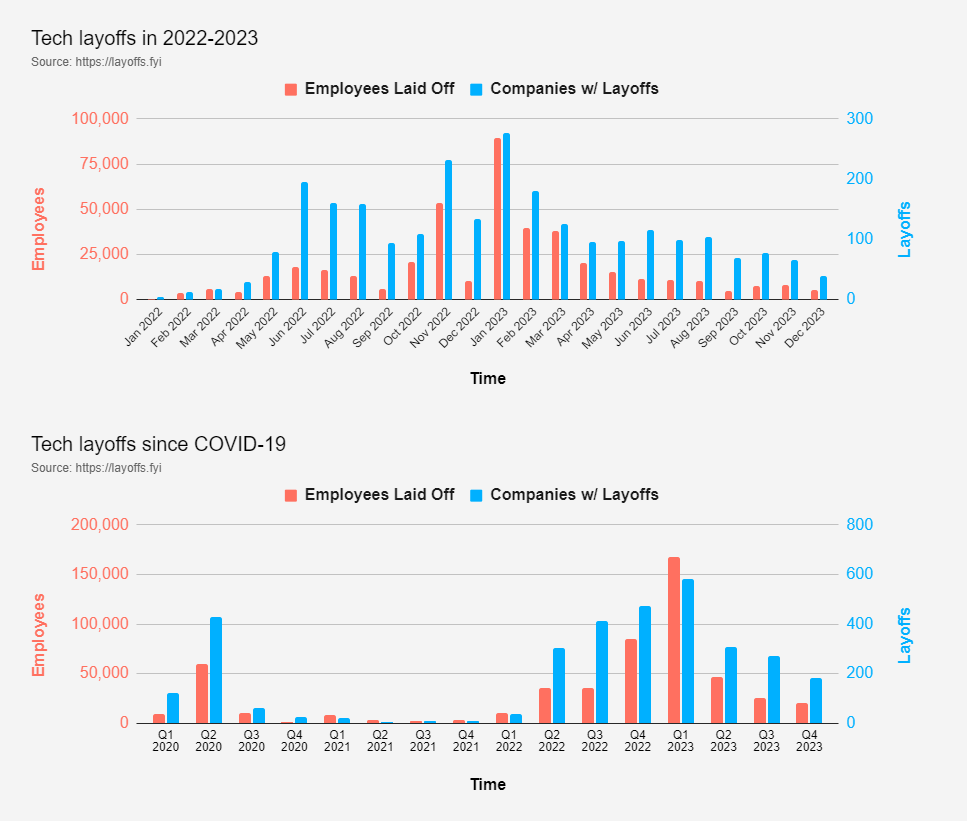
Despite these layoffs, the job market for IT professionals remains challenging. Only a small fraction of laid-off workers have found new jobs as of January 2023. The rest are competing for positions in a market characterized by hiring freezes and ongoing layoffs, despite their qualifications and experience.
In examining the impact of artificial intelligence on job layoffs in the IT industry, we can look at specific examples from recent years:
- Dropbox: Announced the layoff of approximately 500 employees, citing worsening economic conditions and significant technological developments, particularly in AI.
- IBM: Plans to replace nearly 8,000 jobs with AI, focusing on back-office functions, especially in the human resources sector.
- Chegg: Disclosed plans to cut about 4% of its workforce, acknowledging the impact of OpenAI’s ChatGPT on their business.
- Accenture: Announced a $3 billion investment in AI technology after laying off 19,000 employees earlier in 2023.
- Microsoft: Disclosed plans to lay off 10,000 employees, aligning with the company's strategy to expand its AI offerings.
- Stack Overflow: Announced the layoff of 28% of its workforce to replace them with AI-driven coding assistants.
- Google (Alphabet): Engaged in another round of layoffs, affecting hundreds of employees within its recruiting team.
- Amazon: Laid off employees from its retail sector, where roles are being replaced with AI and automation technologies.
3: Impact on freelancers
The tweet by John Burn-Murdoch discusses a study that observed the impact of ChatGPT on the online freelancing platform after its launch. The study reveals that freelancers experienced a decline in both the number of jobs they received and their earnings. The decline in earnings was steeper than the decline in jobs, indicating that not only did AI take away work from freelancers, but it also devalued the work that remained. Furthermore, the study found that highly skilled freelancers were just as likely to see a decline in employment and earnings as other workers, suggesting that higher skill levels were not a defense against the disruption caused by AI.
Conclusion: The Disruption of Freelancing by AI
The proliferation of AI technologies, particularly generative AI, extends beyond corporate layoffs, reaching into the world of freelancing. As detailed by John Burn-Murdoch, AI has significantly disrupted the freelancing market, where platforms like Upwork have seen a marked decrease in jobs and earnings for freelancers since the introduction of ChatGPT. This effect underscores a broader trend: while AI can augment productivity and quality of work in structured environments, it also possesses the capacity to devalue and dis
Do you need help implementing a practical use of AI in your company?
Write to me on Twitter or LinkedIn, I will be happy to help you!
Stay up to date with practical ideas for using AI in business - sign up for our newsletter.
We write rarely, but only the best content 😉

Dawid Adach
Co Founder atMDBootstrap/ Listed in Forbes „30 under 30" /EOer
For years he has been working as an IT Consultant in countries like Netherlands, Belgium, Poland or India developing enterprise class systems for the biggest companies within domain.
Since 2016 he is a co-founder of MDBotstrap.com - world class UI Framework used by NASA, Amazon, Nike, Airbus, Samsung, Apple and many other Fortune 500 Companies.