Using the company's internal data to build an AI Chatbot that empowers your team
Introduction
In today’s rapidly evolving business landscape, the efficient management and utilization of internal data have become crucial. Companies are sitting on a goldmine of internal data, often underutilized.
One of the simplest and most useful ways to start implementing AI solutions in a business is by utilizing internal data to create a helpful chatbot for your own team.
This is exactly what we do in our company and what I wanted to share with you so that you can also use it in your business.

Why create AI chatbots based on internal knowledge?
The most important reason is the fact that publicly available chatbots, such as chatGPT, do not have access to the latest knowledge (e.g. chatGPT does not know anything about the latest version of MDB, which was released on December 4, 2023, because openAI's knowledge at this point ends in April 2023).
Only our own bot, with additional information provided by us, is able to correctly answer such a question.

The second reason is that the most valuable resources of internal company knowledge are obviously not and should never be publicly available - therefore no public chatbot should ever have access to them.
At the same time, it is a valuable resource that can become priceless with the help of AI.
What exactly do we do?
Since the beginning of our company, we have made great efforts to ensure that there is no valuable knowledge within the team that is not written somewhere and available to everyone.
What I mean here is knowledge from various aspects, such as:
- Marketing - e.g.: "What steps should you take care of when preparing a new promotional campaign?"
- Programming - e.g.: "What are good practices for writing code in our projects?"
- Managerial - e.g.: "How do we set and verify quarterly goals?"
- HR - e.g.: "What should you remember when starting a new recruitment?"
- General - e.g.: "What are the rules for taking longer leaves?"
And so many more. Even little things like "How do I turn off the office alarm?" or "Which cabinet has the coffee supplies?".
Over the years of following the principle that everything useful or repetitive should be saved and available to the rest of the team, our internal knowledge base has grown to include several dozen categories that aggregate thousands of pages of valuable company knowledge.
Managing and maintaining such a database is a challenge in itself, but as it grows, a new problem has emerged - it is becoming more and more difficult to quickly find the information we are interested in in this huge amount of data.
A regular search engine simply won't do the trick.
I learned this the hard way when, entering an empty office, I accidentally triggered the alarm, which counted down 60 seconds before it started roaring, waking up the entire building.
So imagine me now, in a hurry, taking out my phone, logging into our knowledge base, and trying to enter the right word in the search engine, hoping that in 60 seconds I will find that one specific page containing information about the code to disable the alarm.
Of course, I didn't succeed, which cost me a long explanation to security and the police that I wasn't a thief, I just forgot the alarm code.
Fortunately, thanks to AI, this will not happen again!
Now all I have to do is launch our Internal Chatbot and in a few seconds I get exactly what I need:
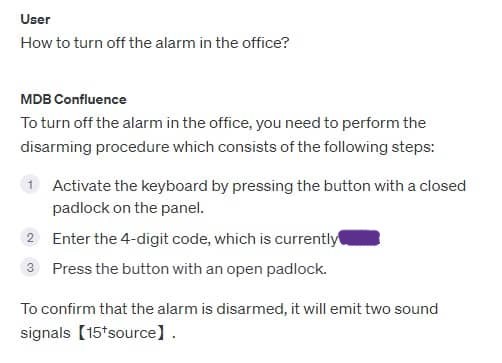
This is, of course, an extreme example of a small but annoying issue. To better illustrate what exactly this chatbot can do, based on the company's internal knowledge, I am attaching a few screenshots with examples of questions and answers below.
Practical examples of real questions and answers
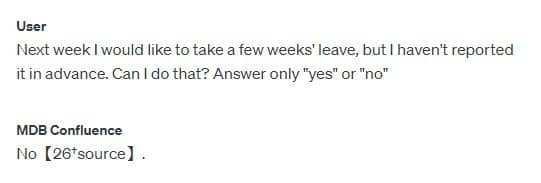
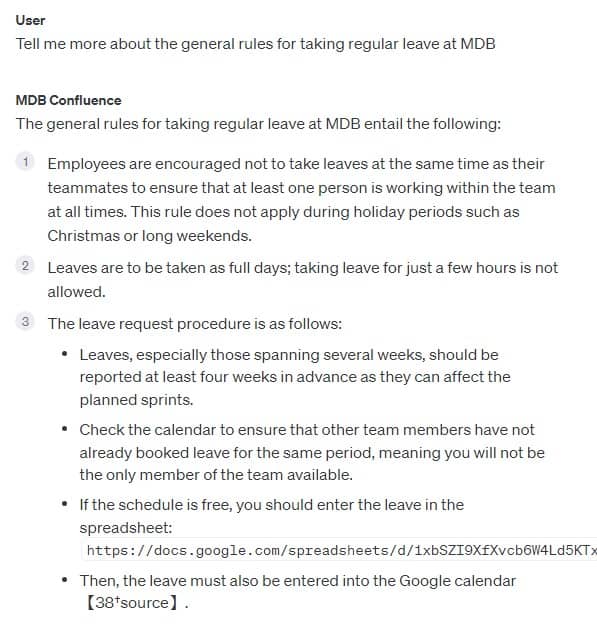
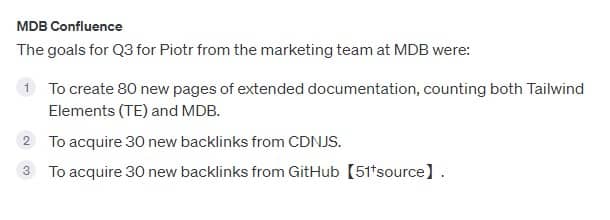
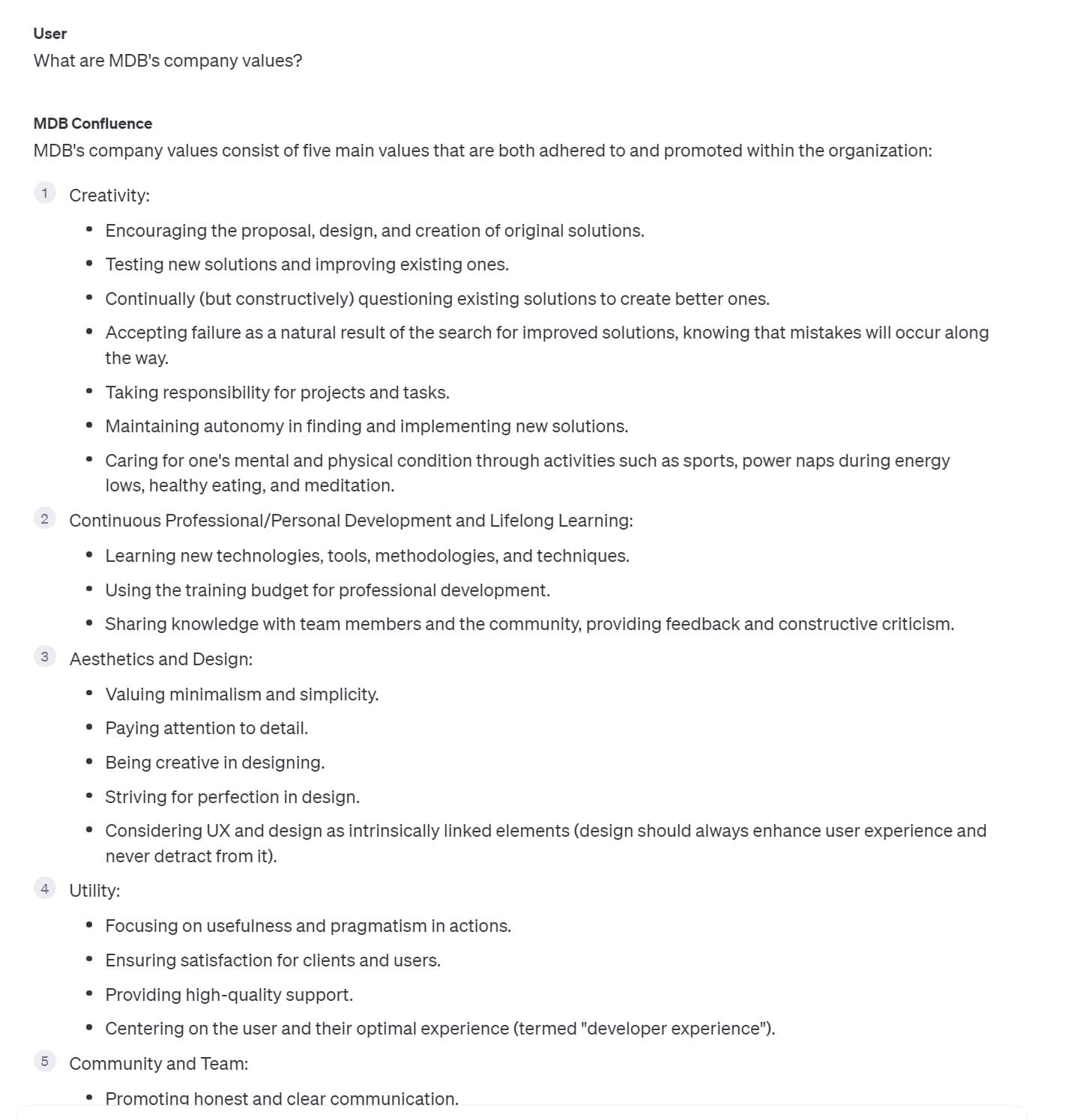
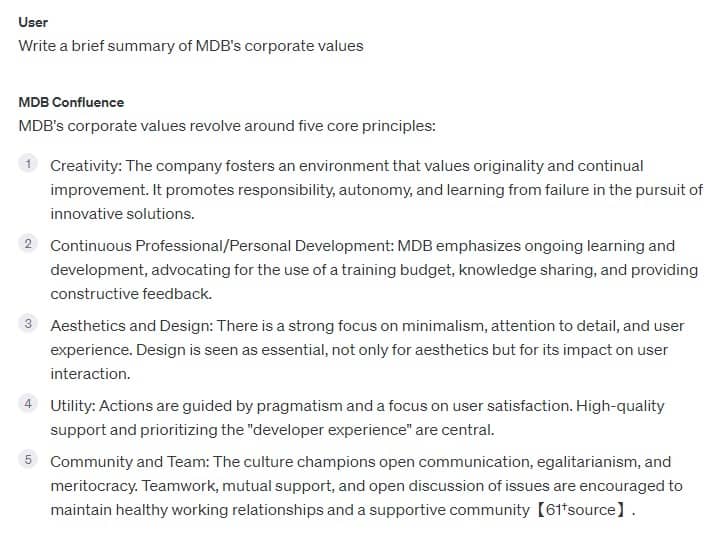
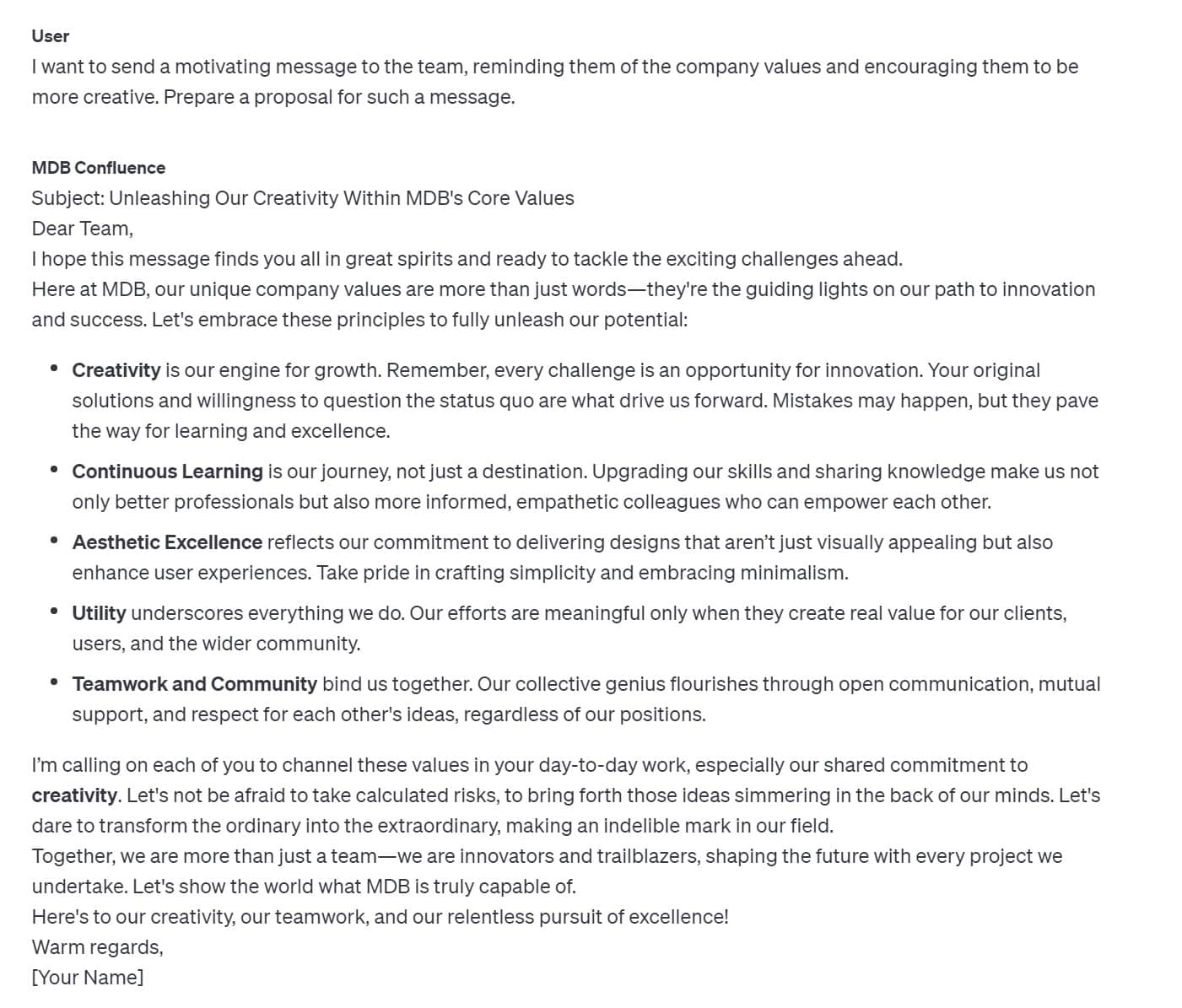
This list of useful questions and answers could go on and on.
But the best part isn't that AI can quickly find the information you need. The most exciting thing is that he can analyze this data and do something with it - do creative work, make a project, propose changes.
The possibilities really are endless.
Caveats
Remember that it's crucial to have valuable and well-maintain data
Before you start implementing AI in your business, one thing should be emphasized - without valuable and well-organized data, no artificial intelligence will be useful to you.
You should have one tool (so-called single source of truth) where all your company knowledge will be maintained and available to the entire team.
We store our internal company knowledge on Confluence hosted on our own servers.
However, the tool is secondary - you can just as easily maintain your knowledge on Google Docs stored on the free Google Drive (although at some point this may become difficult to maintain)
Once you have good data, the rest of the road is clear (but that doesn't mean it's easy).
Be careful while choosing Large Language Model (LLM)
LLM, i.e. large language model, is a computer program that we commonly call artificial intelligence.
For example, the GPT-4 model, created by OpenAI, is used in the famous ChatGPT. It is also the most popular and easiest to implement model.
However, if you want to create your own chatbot based on your own data, the GPT model can be expensive.
For example, a few relatively simple conversations based on the OpenAI API can generate costs of several dozen dollars. The problem is that this solution is practically unsuitable for commercial use - e.g. if you wanted to publish such a chatbot on your website, where every internet user could use it. The costs generated would quickly exceed the potential benefits.
Additionally, the latest API from OpenAI, the so-called Assistant API, although it generates the best responses, still works unstable and very slowly - sometimes you have to wait over a minute or even longer for an answer.
That's why it's definitely worth taking a look at other, lesser-known large language models. The best place to do this is the Hugging Face platform.
Do you need help implementing a chatbot or practical use of AI in your company?
Write to me on Twitter or LinkedIn, I will be happy to help you!
Stay up to date with practical ideas for using AI in business - sign up for our newsletter.
We write rarely, but only the best content 😉

Michal Szymanski
Co Founder atMDBootstrap/ Listed in Forbes „30 under 30" /EOer / Open-source and AI enthusiast /Dancer, nerd & book lover.
Author of hundreds of articles on programming, UI/UX design, business, marketing and productivity. In the past, an educator working with troubled youth in orphanages and correctional facilities.